The Price of False Peace: Duterte, Accountability, and the Wounds Left Behind
Lucas De Guzman 23/11/2025
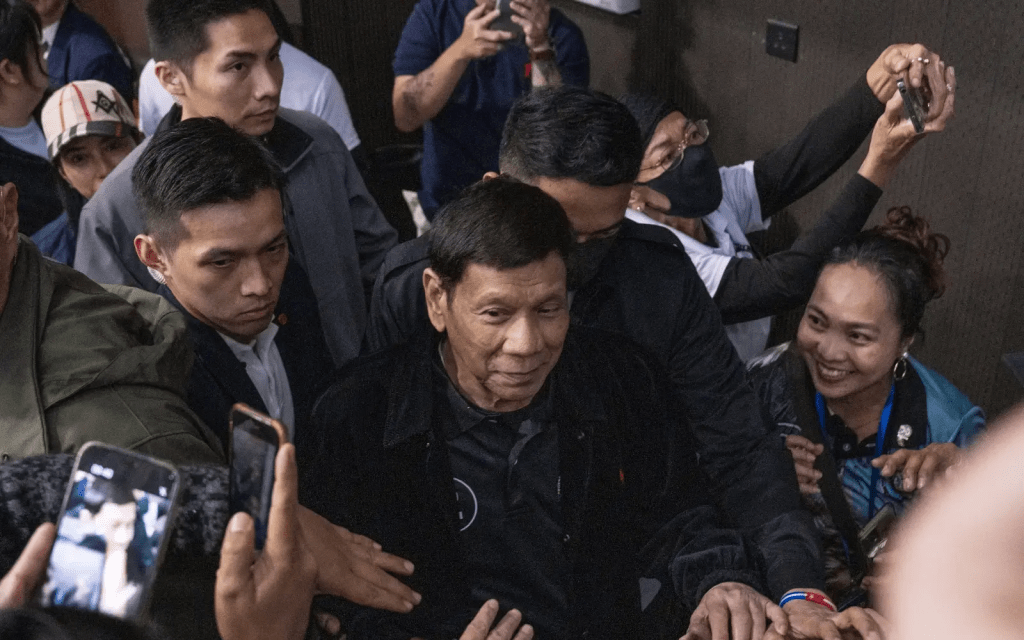
An image depicting Rodrigo Duterte sourced from the International Commission of Jurists
The Philippines is facing a powerful antinomy. The country that has hoped for safety and order that was promised to be instituted under Rodrigo Duterte’s rule now has to tackle issues he caused with the near irreparable wounds his ‘war on drugs’ has left on the social conscience of the country. The peace that was promised to the Filipino citizens now demands reconciliation and justice to resolve the systemic violence enabled by the Filipino local authorities, state policies, and legal and political systems that tolerated or encouraged these harsh methods.
During Duterte’s rise to power, he portrayed himself as a strongman. One who was determined to rectify the disorder in the Philippines in its entirety. Initially, his proposition of a war on drugs was received positively and was felt strongly by many Filipino citizens who believed a tough approach was the only solution to the rampant issues ever-present in the country. This campaign enabled horrible atrocities nation-wide. Amnesty International, Human Rights Watch possess records and documentation of numerous extrajudicial executions and killings without proper due process or the respect of all legal rights owed to a person.
Furthermore, the deaths caused by such a campaign were not isolated and random events. As stated by the ICC (International Criminal Court), these institutions formed a “widespread and systematic attack” on the civilian population of the Philippines. Such tragedies affected families across the country, with many rendered helpless with a lack of system accountability.
Despite this, many felt Duterte’s campaign and drive for peace. Duterte’s consistent affirmations of his goals to kill addicts and populations dealing in drugs were felt strongly by many who felt wronged or let down by the previous rule of law. This peace, however, was never stable. The dependence on the normalisation of violence and the silencing of marginalised voices set up the campaign for failure.
With what many human rights activists state is a milestone, Rodrigo Duterte was detained in March 2025 by the International Criminal Court for his mass violations of human rights. The former Filipino president’s transfer to the Hague marked more than just a legal enactment of justice but also a critical test of the international rules-based order. As stated by Nobel Laureate Maria Ressa, the arrest of Rodrigo Duterte could usher in an age where impunity is no longer allowed to reign unchecked and that accountability is a concept that can stretch across borders.
Where Duterte’s campaign for a ‘war on drugs’ failed is mistaking peace for silence. Peace must be the antithesis of violence not simply the lack of it. To truly achieve this concept it must include accountability from institutes in power and a medium for people who were negatively affected to heal. In the trial of Duterte, the enactment of justice serves as an example on how the foundations of a nation’s peace should be built, not with blood but with growth and reconciliation.


Leave a Reply